

On every WorldStrides international tour, your experience begins the moment you arrive – when you’re welcomed by one of our dedicated Tour Directors. From that first greeting through to your journey home, they are by your side, ensuring everything runs smoothly and that your group gets the most out of every moment. While the impact they make can be difficult to fully capture without experiencing it firsthand, it’s often best reflected through the voices of those who travel with them.
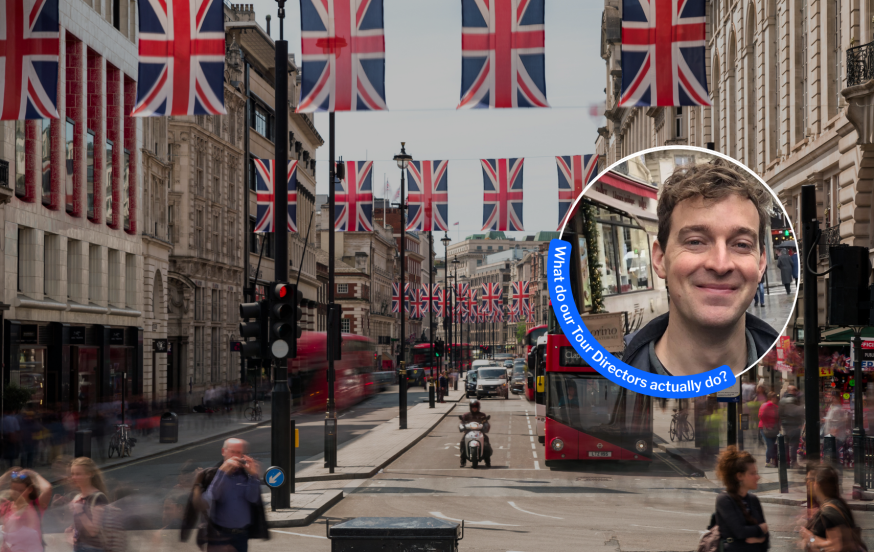
To give you a closer look at the value our Tour Directors bring, we sat down with one of our own, Adam Self. Adam received exceptional feedback from a Program Leader who travelled with their group to the UK and London last year:
“Adam Self was the most perfect Tour Director we could have possibly imagined. We are beyond grateful to have been paired with him and will be requesting him again in the future. Adam is friendly, approachable, highly professional, calm and knowledgeable. All the traits we could have asked for. It was very clear from the first conversation that Adam was completely organised and prepared for the tour and had done an incredible job mapping out logistics for our group. He was a great professional pair for our Program Leader, Chelsea, who matched each other’s organisational skills.
The quick thinking of Adam was tested on day one, with one of our big-ticket items being cancelled, and the way Adam and our Program Leader Chelsea, handled this so quickly and professionally ensured the kids still had an exceptional experience and ultimately proved how dedicated Adam is to his role. This professionalism never faltered; however, he still managed to make exceptional connections with the students, and his interpersonal skills were excellent. We are all very fond of our experience with Adam – there were some teary goodbyes at the airport, and we are really grateful for our time with him.” – Young People’s Theatre Newcastle
This is a longer read, but one well worth your time if you’d like to learn more about how our Tour Directors elevate and support every WorldStrides international adventure.
Can you tell us a bit about your background and how you became a Tour Director with WorldStrides?
After finishing school, I studied Primary (Elementary) Education at University, with the intention of becoming a teacher. I loved working in schools and with students during my placements on the course, but various things made me think that being a conventional teacher wasn’t quite the right path for me. To pay the bills during my time at Uni, I worked as a steward in a concert venue which hosts live events, such as music, dance and comedy shows, and I fell in love with the excitement of the industry. After leaving Uni, I became an Event Manager at the same venue, coordinating the logistics, staff and artists involved in making each event happen, and being the key person at the venue to ensure things ran smoothly and safely. I loved it, and still work occasionally at the same venue, and others, around my tours. I applied to be a Tour Director thanks to a colleague at the venue, who’d been working with Explorica (now part of WorldStrides) for some years. He felt I had an aptitude for the job and encouraged me to apply. In the decade since I became a TD, we’ve been lucky enough to work together on a few unusually big tours which required two TDs – it has been great fun!
What drew you to this role, and what do you love most about it?
I was drawn to the role by the prospect of combining my love of education and working with students with my love of live events. A tour after all is the ultimate event! Tour Directing seems the perfect blend of these two elements. It gets me out into the world, challenges me, and connects me to people and situations I never thought I’d encounter.
What does a typical day on tour look like for you?
Life on tour usually involves long days and meticulous organisation. The job is very multifaceted but primarily involves coordinating the itinerary itself and coordinating the group around the itinerary.
At breakfast, whilst making sure all is well with the hotel’s offering, I’ll take the opportunity to join the students and teachers – getting to know the group is one of the joys of the job. We’ll all gather before heading out, and I’ll speak to the group as a whole to ensure they understand the plan for the day and that they have everything they need.
Every day on tour is so different – by way of a few examples, if making a visit to a museum or attraction, I’ll ensure everyone has their tickets, knows some key information about what to see and where to go, and will set a meeting time and place to gather afterwards, ensuring there’s enough time available to do the visit justice. After making sure the group get inside smoothly, I’ll usually go to a nearby cafe and work on the logistics of future days, or even on planning my next tour – there’s always a heap of admin work to take care of. If taking a guided tour of a city, I’ll work with the local guide to ensure they understand what the group are expecting to see, and that all promised elements are well covered. If taking a journey on public transport, I’ll ensure we all get to our destination, and will involve the students as much as possible in the working-out of the journey, even encouraging them to take my flag and lead the way. If travelling by bus, I’ll work with the driver to ensure we stay on schedule and will arrange the best place for us to get off at our destination, whilst surely delivering some educational content to engage the group on route.
Most days usually include some free time, at least for lunch. I’ll typically recommend places to eat and shop, perhaps suggesting some local delicacies or products. At dinner, I’ll help ensure any dietary requirements are noted and that the meal is up to our standards, usually taking the opportunity to sit with the group and get to know them better during the meal. After dinner, there’ll sometimes be another element to the itinerary, or the group may have their own plans. I’ll work with the PL to ensure we can maximise the available time. Before the day is out, I’ll share the next day’s itinerary with the group in the form of a poster, plus any key info about the day or what to bring.
Sleep on tour is usually short, but deep!
How do you prepare for a tour before the group even arrives?
I receive the itinerary of each tour 10 days before the group arrives. First, I go through it to ensure every element is booked and workable. Often, I’ll propose switching the timing or dates of certain elements to achieve a better flow for the group, or chase missing bookings. I’ll communicate with the PL to ensure the plans are as they expect, and check that details regarding things like hotel rooming and dietary requirements are correct. Once everything is looking good, I’ll make contact with each and every ‘supplier’, such as the hotels, restaurants, guides and bus companies, etc, to ensure our bookings are confirmed and that all details are correct. It’s a lot of work, but this stage is crucial to ensuring a successful tour.
What’s one thing most people don’t realise about what a Tour Director does behind the scenes?
Group members often ask me, “what do you do when we’re [in a museum/on free time, etc.]?” I think they imagine I sit and read my book or something! The amount of work required to make all the final arrangements for each activity, research upcoming visits and prepare educational activities often goes unnoticed.
Can you share a moment or story from a tour that really stuck with you?
As a high-school student myself, I found school trips extremely challenging. I’m actually an introvert to this day, and would get very overwhelmed and homesick on relatively local school trips. I don’t think I’d have even contemplated going on an international tour at the time! I’d like to think I have a radar for introverts in my groups, and that I bring a calm energy which helps create an inclusive and accessible atmosphere. On a couple of occasions, I’ve connected with students in crisis and helped them to feel more at home – these moments stay with me as some of the most important connections I’ve made over the years. Travelling isn’t easy for anyone, so helping to foster a culture of respect, care and trust on each tour is really important to me.
How do you balance logistics and planning with creating an enjoyable, educational experience for the group?
I feel the logistics and planning are an integral part of delivering an enjoyable and educational experience. If you prepare thoroughly, the best outcomes usually follow. Aside from confirming each element of the tour, planning can involve anything from researching the practicalities, history and culture of each place we’ll visit to creating local musical playlists and fun quizzes to help entertain and engage the group during bus journeys.
What’s your approach to working alongside Program Leaders and school chaperones?
My fundamental approach is to communicate as much as possible. I run through the full itinerary with the PL prior to the tour, including my comments about practicalities, timings and logistics, so they understand what each day is likely to look like. I ensure the chaperones understand their role in looking after the students, for example by checking the presence of set students when we travel by metro train, and giving their thumbs-up to the PL. When the TD, PL and chaperones are working in a coordinated and communicative way, and all understand the plans and any restrictions we need to work within, we maximise the group’s safety, available time and enjoyment of the tour. When unexpected things happen on tour and plans need to shift, I ensure the PL is well consulted. At the end of the tour, I make sure that we as a group celebrate the role of the PL in making the tour happen in the first place. Frankly, the PL could’ve enjoyed some relaxing time off work and not taken the risk and responsibility of taking a group across the world. It’s really important to me that the bravery, energy and dedication of the PL and chaperones be fully appreciated, since it truly leads to life-changing and unforgettable experiences.
What strategies do you use to add educational or cultural depth to each tour?
One of my favourite things to do on tour is to play local music – I find it’s a surprisingly powerful way to tap into a culture, identity, language or history in a way that’s also very entertaining and accessible. I aim to employ the LEAP (Learning through Exploration and Active Participation) philosophy of WorldStrides at every opportunity. Rather than simply talking at a group, I try to make discussions happen and provoke deeper engagement. I encourage participation whenever possible – so rather than simply telling the group how we’ll get from one place to another via a metro system, I’ll give them maps, teach them how to read them, and help them to work out the journey themselves. This way, they take away skills for life, that can be applied to any metro system in the world, plus they have much more fun in the process!
I encourage each group I lead to minimise impact on local communities and the environment. Small things everyone can do on a personal level, like speaking a little of the local language (using my posters and language lessons), being mindful of noise levels in public places and hotel corridors, avoiding single-use plastics and using recycling bins for waste, amongst many other things, are ways to be a responsible traveller and indeed global citizen. This kind of awareness and action can bring benefits for the group, everyone around us, and even the next generation.
What’s the most rewarding part of your job?
Travel opens people’s minds and hearts – I’m sure seeing this happen day after day will never get old for me.
What’s one piece of advice you’d give to first-time student travellers?
Bring an attitude of positivity. Travel involves the unexpected. However well a tour is planned, things rarely go exactly as expected due to the chaotic nature of the world. When things don’t go to plan, there’s always a positive. Travel is a great teacher and one of its lessons is to embrace the unexpected.
What’s one piece of advice you’d give to teachers leading tours?
The same as above. Plus, appearing calm in stressful situations is, in my opinion, very important when leading a group in unfamiliar places and situations.
Why do you think having a Tour Director for international tours is such a benefit for teachers?
The complexity of an international tour is not to be underestimated. Having a TD look after the logistics makes for a smoother and safer tour. The presence of a local in the group also adds tremendous cultural value.
Do you have a favourite destination to guide tours in – and why?
I’m often asked this on tour, and my answer is always the same: Switzerland! Its natural beauty is breathtaking. The quaint towns we typically visit come as a welcome change of pace, since Switzerland usually comes between visits to big and hectic cities in Italy and France on our multi-country itineraries.
In 2026 I’m due to visit my home city of Brighton & Hove, UK with a group. Having never had the opportunity to bring a group here in more than fifty tours, it should be very special!
What’s one fun fact about you that students usually find surprising?
I’m a pet-sitter! I sadly can’t have cats or dogs of my own due to being away so much with the job. As an animal-lover, I get my fix by live-in pet sitting during my time off, and consequently have many animal friends around the world!
Ready to start planning an international adventure for your students? Explore our tours or contact us to get started.